

Your ABS light flickers on. You get anxious. You assume the worst. Then you call your mechanic and hear "that'll be $150 just to diagnose it." Stop right there.
Here's the thing: not all OBD2 scanners are created equal, and this is where a lot of car owners get stuck. Most basic scanners only read check engine lights (P-codes). They're useless for ABS and brake system codes. So let's break down exactly how OBD2 scanners handle ABS and brake diagnostics, which tools actually work, and why this matters for your wallet and your safety.
Related: Best OBD2 Scanner for Battery & Alternator Codes 2026
In this article
- Why Most Auto Parts Stores Can't Scan ABS Codes
- What OBD2 Scanners Can Actually Read for ABS and Brakes
- Which BLCKTEC Scanners Read ABS and Brake Codes
- How to Read Your Own ABS Codes
- What Each ABS Code Category Means
- Can You Drive on an ABS Code?
- Advanced: Can You Clear ABS Codes Yourself?
- Why OBD2 ABS Scanning Beats the Shop Every Time
- Choosing the Right Scanner for Your Needs
Why Most Auto Parts Stores Can't Scan ABS Codes
Walk into AutoZone or Advance Auto Parts and ask them to scan your ABS light. They'll plug in a free scanner and tell you "nope, we can't read that." It's not because they don't want to. It's because their equipment is literally not designed for it.
Standard OBD2 scanners read engine control module (ECM) codes only. ABS codes live on a separate system called the ABS module. To access them, you need a scanner that communicates with multiple vehicle control systems simultaneously.
Most chain retailers have old equipment. ABS scanning isn't profitable for them. So they stick with what they've got. Meanwhile, you're left guessing what's actually wrong with your braking system.
This is where owning your own BLCKTEC scanner changes the game. You get full visibility into what your car is telling you, not just the codes the shop feels like checking.
What OBD2 Scanners Can Actually Read for ABS and Brakes
A quality OBD2 scanner does three things at once: reads engine codes, ABS codes, and SRS (airbag) codes. Some also pull transmission and other system data. The key word is "quality."
Related: OBD2 Scanner Transmission Fluid Warning Codes Explained
When you plug a capable scanner into your vehicle's OBD2 port, it communicates with every electronic module in the car. The ABS module responds with diagnostic trouble codes (DTCs) that tell you exactly what's wrong.
Common ABS codes start with "C" (not the "P" codes you see for engine issues). For example:
- C0035: Right front wheel speed sensor circuit
- C0040: Left front wheel speed sensor circuit
- C0050: Right rear wheel speed sensor circuit
- C0055: Left rear wheel speed sensor circuit
- C0236: ABS modulator pump motor fault
- C1234: ABS control module communication error
These codes tell you if your wheel speed sensors are failing, if the ABS pump motor is broken, or if there's a wiring problem. No guessing. No fake diagnostics charges.
Which BLCKTEC Scanners Read ABS and Brake Codes
Here's where we get honest: not every scanner at every price point reads ABS codes. The 400 - Entry Level scanner handles basic engine codes. Good for a first-time buyer. But if ABS diagnostics matter to you, you need to step up.
The 420 - Standard Diagnostics and 440 - Advanced Diagnostics handle engine, ABS, SRS, and transmission codes. The difference is the 440 has more features and faster performance, but both get the job done for ABS work.
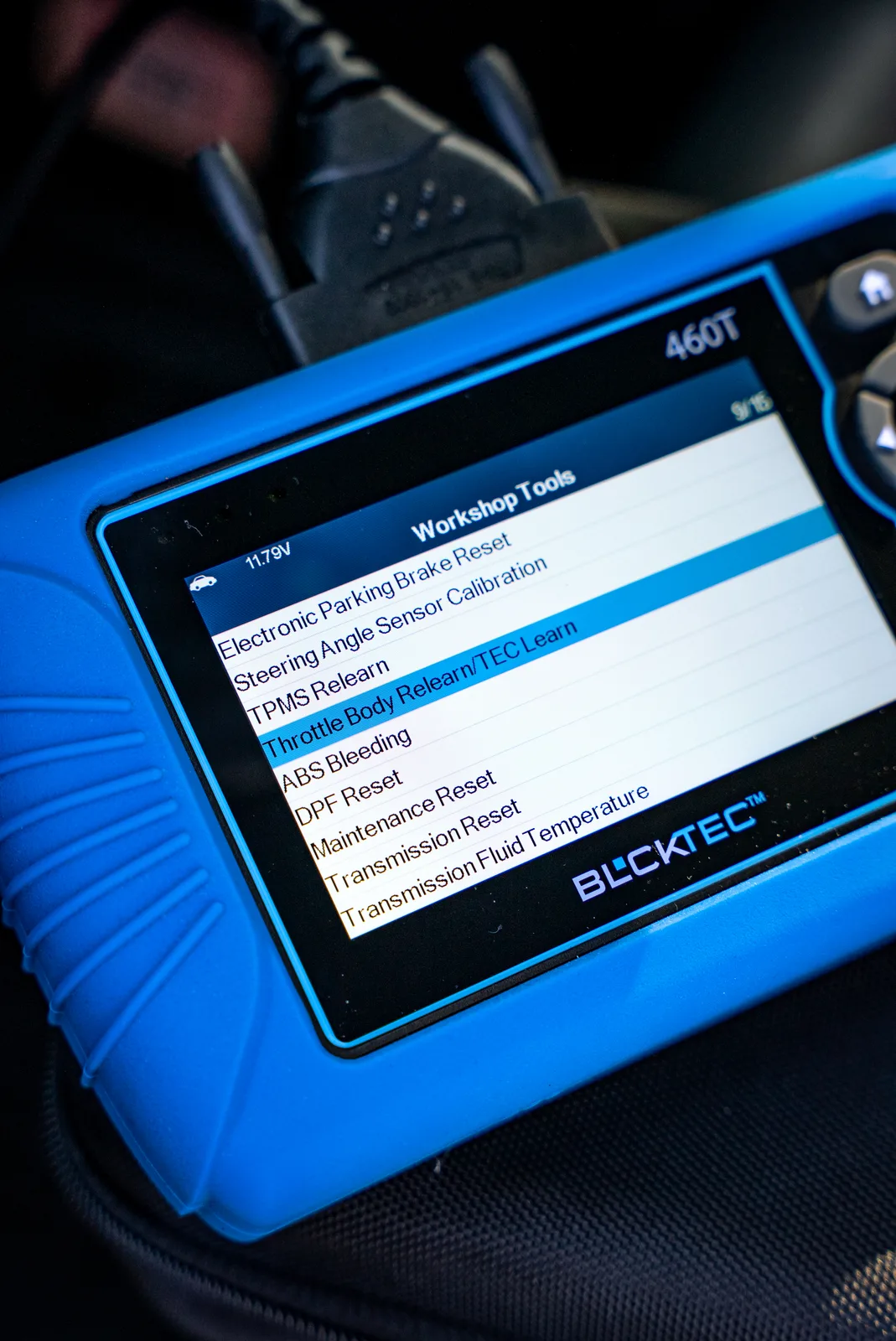
The 460T - Diagnostic Tablet is the full-power option. Tablet interface, wireless connectivity, and the deepest diagnostic reach across all vehicle systems. If you're running a used car lot or doing repairs professionally, this is where you live.
All of these are built to read real-time ABS sensor data, freeze frame information, and pending codes before they turn into warning lights. That's the advantage of being a BLCKTEC owner.
Looking for an OBD2 Scanner?
Explore BLCKTEC →How to Read Your Own ABS Codes

Let's walk through the actual process. It takes five minutes.
- Turn on your ignition without starting the engine. Don't crank it yet.
- Locate your OBD2 port. It's under the steering column on most cars, a rectangular 16-pin connector. You can't miss it.
- Plug in your scanner. A good handheld scanner will power on automatically.
- Select "Read Codes" or "Scan Vehicle." The scanner communicates with your car's modules.
- Wait for results. In 10-30 seconds, you'll see every active and pending code, including ABS codes.
- Write down the codes. Note the code number (like C0040) and the description.
Once you have the code, you can look it up online or call your mechanic with the exact information instead of describing a symptom. You just saved yourself the diagnostic fee. Seriously.
What Each ABS Code Category Means
Not all ABS codes are equal. Some are serious. Some are minor sensor noise. Here's what you're actually dealing with.
Wheel Speed Sensor Codes (C0030-C0060): These are the most common. Your ABS system monitors how fast each wheel is spinning. If a sensor fails, the ABS light turns on. These typically cost $100-300 to fix depending on the vehicle. Not catastrophic.
ABS Module and Pump Codes (C0200+): These mean the ABS control module itself or the hydraulic pump is having problems. More serious. Could be $500-1,500 depending on your car.
Communication and Electrical Codes: Loose connectors, corroded wiring, or a failing module relay. These can sometimes be a quick fix (tightening a connector) or require professional help.
The important thing: You'll know the difference before you call anyone. That's power.
Can You Drive on an ABS Code?
This is the question everyone asks. The short answer: yes, usually. Your regular brakes still work. The ABS just won't engage in emergency situations.
But here's what the National Highway Traffic Safety Administration says: ABS is a safety system. You should get it diagnosed and repaired as soon as reasonably possible. Don't ignore it for months.
That said, knowing the code means you can make an informed decision. You're not blindly driving on a system you don't understand.
Advanced: Can You Clear ABS Codes Yourself?

Yes. Any quality OBD2 scanner can clear codes once you've identified them and addressed the underlying issue. But here's the rule: only clear a code after you've fixed the problem. If you clear it without fixing anything, it just comes back.
If your wheel speed sensor failed and you replaced it, clear the code and the ABS light goes off. That's proper. If you clear a code without doing the repair, you're just hiding a warning sign. Don't do that.
Why OBD2 ABS Scanning Beats the Shop Every Time
Let's be real about the financial side. A typical mechanic charges $100-150 just to plug in a diagnostic scanner and tell you what's wrong. Then they charge for the repair on top of that. You could spend $200+ before you even know what needs fixing.
Related: When to Use OBD2 Scanner Before Buying Used Car
With your own scanner, you spend once and get unlimited diagnostics forever. You read ABS codes on your car, your friend's car, family members' vehicles. One purchase pays for itself the first time you use it.
Plus, you walk into the shop informed. You say "my code is C0040, left front wheel speed sensor." The mechanic can't oversell you on extra work. You know what the actual problem is.
Choosing the Right Scanner for Your Needs
If you're a DIY owner who changes your own oil and wants to understand your car, the 440 - Advanced Diagnostics is the sweet spot. It reads ABS, SRS, and engine codes. It's affordable. It's reliable. It does the job without overwhelming you with features you don't need.
If you're running a used car lot or doing repairs semi-professionally, you need the 460T - Diagnostic Tablet. Full capability. Wireless. Multiple vehicle brands and model years covered.
Either way, BLCKTEC gives you the same thing: peace of mind, transparent diagnostics, and the ability to make smart repair decisions without getting ripped off.
Do I need a special cable for ABS scanning?
No. The OBD2 port is the same on every car made since 1996 in the US. The same cable works for engine codes, ABS codes, transmission codes, everything. Plug it in and go.
Can ABS codes come and go on their own?
Sometimes. If it's a loose connector or intermittent sensor, the code might pop up, then disappear for weeks. That's why a scanner that stores pending codes is valuable. You can catch these ghosts before they become real problems.
Related: Best OBD2 Scanner for Catalytic Converter Problems 2026
Are ABS codes the same across all car brands?
Mostly yes. The C-code format is standardized. A C0040 code means the same thing on a Toyota as it does on a Ford. That's the beauty of the OBD2 standard. One scanner works everywhere.
What if my scanner reads the code but I don't understand it?
Call BLCKTEC support. We're US-based and we answer the phone. We can walk you through what a code means, help you decide if it's DIY-fixable or requires a mechanic, and give you honest guidance. That's part of what you're paying for.
Looking for an OBD2 Scanner?
Explore BLCKTEC →