

Your car battery is failing, and you're staring at a dead engine wondering if it's the battery itself or something draining it. Here's how to diagnose car battery problems with a scanner and take control of your repair decisions.
In this article
- Why Use a Scanner to Diagnose Battery Problems?
- Step 1: Get a Baseline Battery Voltage Reading
- Step 2: Connect Your OBD2 Scanner and Check System Voltage
- Step 3: Test Alternator Output With the Engine Running
- Step 4: Identify Parasitic Drain Issues
- Step 5: Compare Live Data and Look for Anomalies
- What to Do With Your Findings
- Why This Approach Saves You Money
- Choosing the Right Scanner for Battery Diagnostics
- Common Battery Diagnosis Mistakes to Avoid
Why Use a Scanner to Diagnose Battery Problems?
An OBD2 scanner reads your vehicle's onboard computer, which monitors charging system voltage and alternator output in real time. Your battery doesn't operate in isolation—it's part of a larger electrical system managed by your engine control unit. A scanner shows you what the computer "sees" about that system's health, catching problems a simple voltage test might miss.
Related: Best OBD2 Scanner for DIY Car Owners 2026: Top 5 Ranked
Related: Best OBD2 Scanner for Catalytic Converter Problems 2026
The advantage is clear: you get data your mechanic would charge you to retrieve. No guesswork, no upsell, no surprises when you get the repair bill.
If you're ready to diagnose battery issues yourself, BLCKTEC makes scanners designed exactly for this—affordable, easy to use, and capable of unlimited scans so you can check your vehicle as often as you need.
Step 1: Get a Baseline Battery Voltage Reading
Start with the engine off. Using a digital multimeter, touch the red probe to the positive battery terminal and the black probe to the negative terminal. A healthy battery at rest reads between 12.2 and 12.6 volts. If your reading is below 12.2 volts, your battery is weak or discharged. If it's significantly lower (say, 11 volts or less), the battery is likely dead.
This is your starting point. Write down the number so you can compare it to your alternator reading later.
Step 2: Connect Your OBD2 Scanner and Check System Voltage
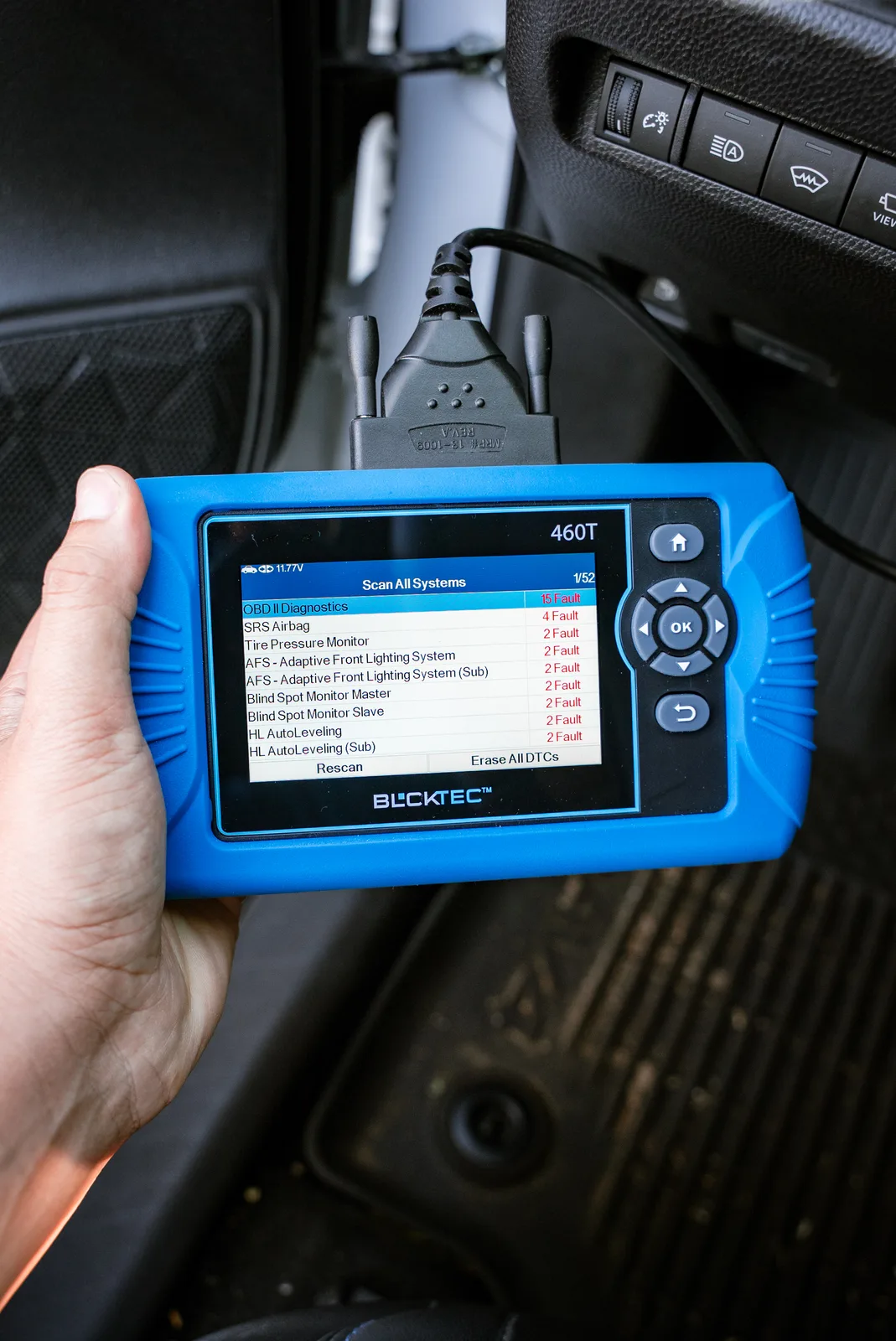
Plug your scanner into the OBD2 port (usually under the steering wheel or dashboard). Most vehicles have this standard diagnostic port. Turn on the ignition (don't start the engine yet) and let the scanner communicate with your vehicle's computer. Look for the "System Voltage" or "Battery Voltage" parameter—this shows what the computer is reading from your battery.
This digital reading should align closely with your multimeter result. If there's a gap of more than 0.3 volts, you might have a corroded connection or a sensor issue. Clean your battery terminals with a wire brush and retest.
Step 3: Test Alternator Output With the Engine Running

Now start the engine and let it idle. Keep your scanner connected and watch the System Voltage reading. With the engine running, your alternator should be charging the battery, and voltage should climb to between 13.6 and 14.6 volts. This tells you the alternator is doing its job.
Voltage above 14.6 volts suggests overcharging, which wears out the battery and can damage electrical components. Voltage that stays below 13 volts while the engine runs means your alternator isn't charging properly and your battery is being drained instead of replenished.
Use your multimeter to double-check this reading across the battery terminals while the engine idles. The scanner and multimeter should show similar numbers.
Step 4: Identify Parasitic Drain Issues
If your battery tests fine at rest and the alternator charges properly, but your car still dies after sitting for a few days, you have a parasitic drain. Some electrical component is drawing power when the engine is off.
This is where your scanner becomes invaluable. Many modern vehicles allow you to check the "Battery Current" or "Parasitic Draw" parameter, which shows how much power is being pulled from the battery while the engine is off. Normal parasitic drain is typically under 50 milliamps (mA). Anything above 100 mA suggests a problem.
Some scanners display this directly. If yours doesn't, you can test manually by connecting your multimeter in series with the battery and measuring current draw. Start by disconnecting modules one at a time (or monitoring their status on your scanner) to isolate which system is causing the drain.
Common culprits include a faulty alternator diode, a stuck relay, bad wiring, or a parasitic battery drain from aftermarket accessories. Your scanner will help narrow it down faster than trial and error.
Step 5: Compare Live Data and Look for Anomalies
The power of an OBD2 scanner from BLCKTEC is that you're seeing real-time data from your engine computer. Look for any trouble codes related to the charging system (usually codes in the P0600 range, like P0622 for alternator undervolting). Even if there's no check engine light, codes might be stored in memory.
Looking for an OBD2 Scanner?
Explore BLCKTEC →Also monitor:
- Battery voltage stability (it should not fluctuate wildly)
- Charging system load (the scanner shows how hard the alternator is working)
- Temperature data (extreme heat can affect battery performance)
- Any pending or historical codes related to the electrical system
Related: Best OBD2 Scanner for Battery & Alternator Codes 2026
Collect this data over a few test cycles. Patterns reveal problems. A battery that reads fine once but struggles under load might be failing internally. A voltage that drops sharply when the compressor engages points to alternator weakness.
What to Do With Your Findings

Once you've collected voltage readings, drain data, and any codes, you have three clear outcomes:
Battery is bad: If resting voltage is below 12 volts and the alternator is charging properly, the battery needs replacement. You're looking at a straightforward swap, usually the cheapest fix.
Alternator is failing: If voltage doesn't rise above 13 volts when the engine runs, the alternator isn't charging. This is more involved but still DIY-able on many vehicles if you're mechanically inclined, or worth taking to a shop with your data in hand.
Parasitic drain is the culprit: If battery voltage is healthy but parasitic draw is high, you need to trace which system is responsible. Your scanner narrows the list significantly, saving hours of guesswork.
Why This Approach Saves You Money
Mechanic shops charge $100 to $150 just to run a battery diagnostic. You've now done that yourself with a multimeter and an OBD2 scanner. You're not paying for the diagnosis; you're only paying for the repair. And because you know exactly what's wrong, you can make an informed decision instead of trusting a shop's recommendation.
If you decide the repair is beyond your skill level, walk into that shop with your scanner data and codes. The mechanic will respect your diligence, move faster, and won't need to re-diagnose the problem.
Choosing the Right Scanner for Battery Diagnostics
Not all scanners show the same parameters. A basic entry-level scanner might read codes but won't display live voltage data or parasitic current. For battery diagnosis work, you need a scanner that shows System Voltage and ideally Charging System Amperage or Battery Current in real time.
The 420X - Standard Diagnostics scanner is built for exactly this kind of work. It displays live sensor data, stores and clears codes, and works on all standard OBD2 vehicles (1996 and newer). No subscriptions, no phone app needed, and BLCKTEC's US-based support team is available if you have questions while testing.
If you're running multiple vehicles or want tablet-based diagnostics, the 460T - Diagnostic Tablet provides more screen real estate and can display dozens of live parameters at once, making it easier to spot trends and correlations in your battery and charging data.
Both are priced to fit a DIY budget, and both come with unlimited scans. Test your battery today, troubleshoot parasitic drain tomorrow, monitor your charging system next month.
Common Battery Diagnosis Mistakes to Avoid
Don't test battery voltage immediately after driving. Let the engine cool for at least 10 minutes, then turn everything off and wait another 5. Residual charging current will skew your readings.
Don't ignore corrosion on battery terminals. Even a thin layer of white or blue oxidation increases resistance and causes inaccurate readings. Clean the terminals before you test anything.
Don't assume a strong resting voltage means the battery is good. A battery can read 12.6 volts and still fail under load. Always test with the engine running and under electrical load (headlights on, compressor running) to stress-test the system.
Don't skip the parasitic drain test. Many battery failures are actually caused by constant drain, not a dead battery or failed alternator. Catching this early saves you from repeated dead batteries and towing bills.
Will my OBD2 scanner show battery voltage on all vehicles?
Most vehicles (1996 and newer with OBD2 ports) display System Voltage or Battery Voltage as a standard parameter. However, some older or obscure models may not include it in their standard data stream. Your scanner will connect and show available parameters; if System Voltage isn't there, your multimeter test becomes your primary diagnostic tool. That's why having both methods—scanner and multimeter—gives you the most complete picture.
What voltage reading means the alternator is bad?
If the engine is running at idle or above 1,500 RPM and voltage stays below 13 volts, or if voltage fluctuates wildly (jumping more than 0.5 volts in a short period), the alternator is likely failing. The alternator should deliver steady, smooth charging in the 13.6 to 14.6 volt range. Anything outside that zone, consistently, points to alternator replacement.
Can a parasitic drain be fixed without a mechanic?
Sometimes. If the drain is caused by a stuck relay that you can access, or a light that's wired incorrectly, you might fix it yourself. But if the drain is internal (like a bad alternator diode or a module with faulty wiring), professional diagnosis and repair are usually necessary. Your scanner's data will tell a mechanic exactly where to look, cutting down repair time and cost.
How often should I test my battery and alternator?
Once a year is a good preventive rhythm, especially before winter or long road trips. If your car has a history of battery issues, test every six months. And of course, anytime you notice slow cranking, dim lights, or a battery warning light, grab your scanner and multimeter immediately. Early detection prevents roadside breakdowns.
Looking for an OBD2 Scanner?
Explore BLCKTEC →