


Your check engine light just came on. Your stomach drops a little. You're thinking about the repair bill, the time off work, the hassle of taking it to a mechanic you may or may not trust.
Here's the thing though: you don't have to pay a dime to find out what's actually wrong with your vehicle. Free check engine light testing is available today at stores you probably drive past all the time.
Let me walk you through exactly where to go, what to expect, and how to read the results so you can make smart decisions about your car.
In this article
- Where to Get Free Check Engine Light Testing
- What Happens During Free Check Engine Light Testing
- A Smarter Option: Borrow or Buy Your Own Scanner
- What Those Trouble Codes Actually Mean
- When Free Testing Might Not Be Enough
- Pro Tips for Getting the Most Out of Free Testing
- Building Confidence in Your Vehicle's Health
- Frequently Asked Questions
Where to Get Free Check Engine Light Testing
The major auto parts retailers offer free OBD-II code scanning as a standard service. No appointment. No pressure. Just walk in and ask.
AutoZone - The biggest chain and usually your closest option. Staff will scan your vehicle in the parking lot in about 5 minutes. They'll print out a report with the trouble code and basic information about what it might mean.
O'Reilly Auto Parts - Also free. They use a system called VeriScan that gives you a verified diagnostic report right on the spot. Takes about the same time as AutoZone.
Advance Auto Parts - Free scanning available. Just let an employee know your check engine light is on and they'll grab a scanner.
NAPA - Typically offers free code reading at most locations, though a few franchises may charge a small fee. Worth calling ahead if there's one near you.
The best part? You don't need an appointment. Most of these stores have multiple scanners on hand. Even during busy Saturday afternoons, you're usually in and out in 10 minutes.
What Happens During Free Check Engine Light Testing
When you pull up to one of these stores, here's what the process actually looks like.
You tell a staff member your check engine light is on. They walk you outside (or ask for your keys). They plug an OBD-II scanner into the diagnostic port under your steering wheel or dashboard. That port is on every car made since 1996.
The scanner reads the trouble code stored in your vehicle's computer. This takes 30 seconds to 2 minutes depending on the scanner and how many codes are stored.
The staff member prints out a report or shows you the screen. The report includes:
- The diagnostic trouble code (like P0420)
- A plain-English description of what that code means
- Potential causes of the problem
- Common fixes or next steps
That's it. You now have information that would cost you $50 to $150 if you went to a dealership or independent shop for diagnostics.
A Smarter Option: Borrow or Buy Your Own Scanner
Here's something many people don't know: some auto parts stores will actually let you borrow an OBD-II scanner for free to use yourself in the parking lot.
Why would you want to do this?
Because you own the information. You're not depending on a staff member's interpretation. You can take the scanner home and run multiple tests. You can check codes again after you think you've fixed the issue. You're in complete control.
Ask when you call or visit. Many stores have loaner programs, though policies vary by location.
If you find yourself doing this more than once or twice a year, it makes sense to own your own scanner. BLCKTEC makes OBD-II diagnostic scanners that read and clear trouble codes, and they're affordable enough that the investment pays for itself after one avoided diagnostic fee.
Looking for an OBD2 Scanner?
Explore BLCKTEC →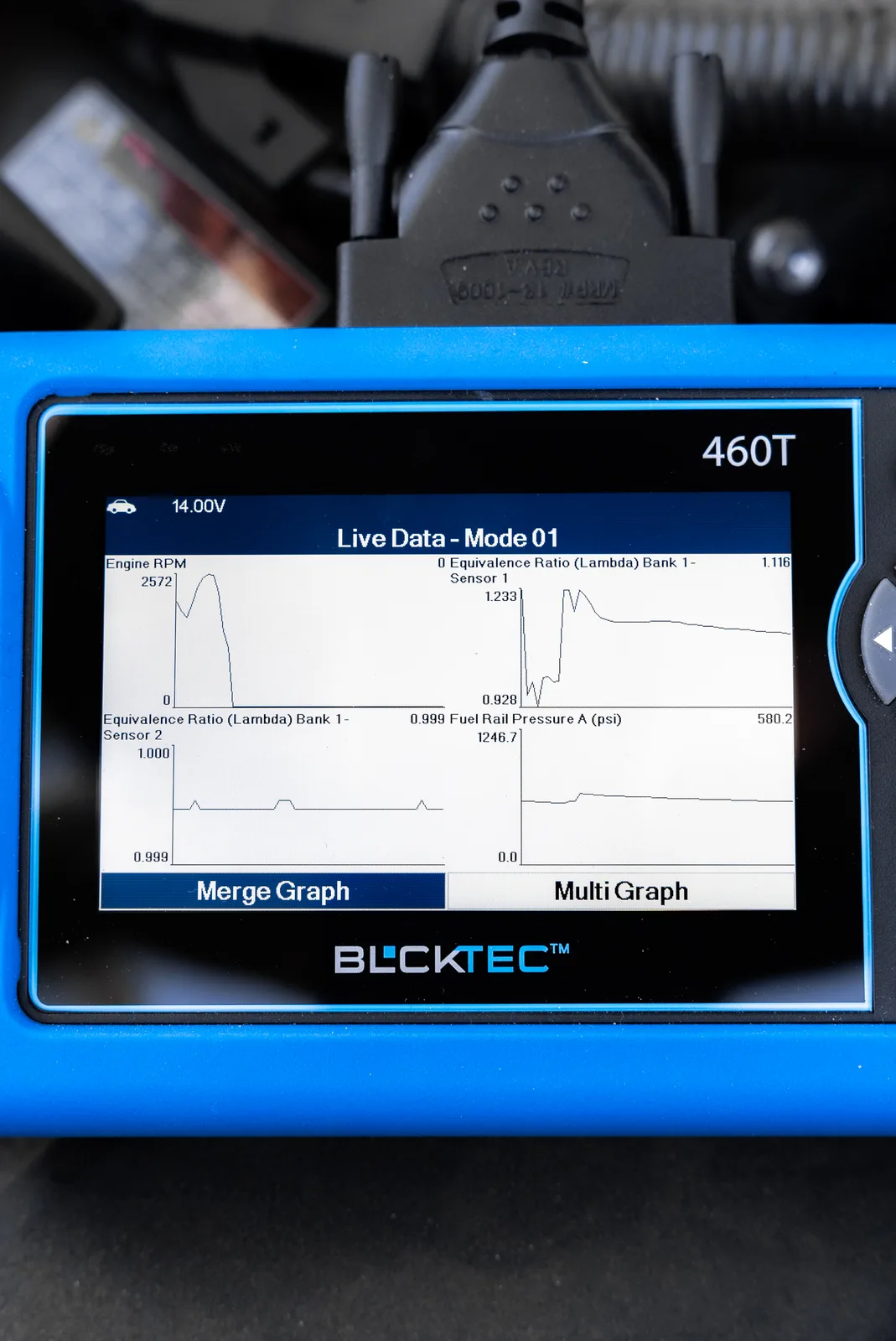
What Those Trouble Codes Actually Mean
A trouble code like P0420 doesn't automatically mean "your engine is about to explode." It's a specific flag that points toward a system or component that needs attention.
P0420, for example, means your catalytic converter might be failing or your oxygen sensor might be bad. That's very different from a P0101 (mass airflow sensor issue) or a P0171 (fuel system running too lean).
The diagnostic report from AutoZone or O'Reilly will explain this in simple terms. You're looking for the description that says something like "Possible causes: bad spark plugs, vacuum leak, fuel injector clogged" so you know whether this is a $50 fix or a $2,000 fix.
According to the National Highway Traffic Safety Administration (NHTSA), around 75% of vehicles on the road have a check engine light issue that's either minor or can be deferred. That means most of the time, your car isn't dying. You just have information now.
When Free Testing Might Not Be Enough
Free code scanning tells you what code triggered the light. It doesn't always tell you the root cause, especially for intermittent issues.
Example: You get a P0300 code (random misfire). That could be bad spark plugs, a failing coil pack, a vacuum leak, a weak fuel pump, or carbon buildup in the engine. The code narrows it down. But you might need more testing to know for sure.
That's where having your own diagnostic scanner becomes valuable. If you can run multiple scans and check live data (like fuel trim, oxygen sensor readings, or ignition timing), you can usually figure out what's happening without paying a mechanic $100 for an hour of labor.
Many people use free store scans as a starting point, then do their own research or grab a better scanner if they need more detailed information. BLCKTEC scanners give you that power at a price that makes sense.
Pro Tips for Getting the Most Out of Free Testing
Be polite. Staff at auto parts stores are usually helpful, especially when you're respectful. A few people have reported that being courteous occasionally results in a free code clear if the issue is minor or benign. No promises, but kindness doesn't hurt.
Ask questions. The staff member scanning your car isn't a mechanic, but they've heard hundreds of diagnostic stories. Ask what they've seen with that code before. Ask if it's usually urgent or if it can wait a week or two.
Write down the code and description. Take a photo of the report or jot down the exact trouble code. When you're researching the problem online later or calling a mechanic for a quote, you'll want that specific information.
Check online forums for your vehicle. Once you know your trouble code, search that code plus your vehicle's year, make, and model. You'll often find threads from other owners who had the same issue and fixed it cheaply, or who had it quoted by a shop.
Consider a second opinion. If the store report says "you need a new catalytic converter" but you want confirmation, take the code to an independent mechanic or dealership for a second look. Sometimes the cheapest repair is the right call.
Building Confidence in Your Vehicle's Health

One of the biggest stressors of car ownership is not knowing what's wrong when that light comes on. Free check engine light testing removes that mystery. You know what you're dealing with. You can make an informed decision instead of panicking.
Some people stop there. Others decide to invest in their own OBD-II scanner so they can monitor their vehicle's health regularly, catch small issues before they become big repairs, and avoid mechanic upsells based on incomplete information.
If you go that route, you want a scanner that's easy to use, reliable, and backed by real support. That's where BLCKTEC comes in. Built for DIY car owners and budget-conscious drivers who want to understand their vehicle without the complexity or the cost.
But first, take advantage of what's free. Go to AutoZone or O'Reilly today. Get your codes read. Get clarity. Then decide what's next.
Frequently Asked Questions
Does free check engine light testing mean they'll pressure me to buy parts?
Not really. Auto parts stores make money on volume and customer loyalty, not by pressuring you. They know that a good experience brings you back. Staff will suggest common fixes based on your code, but they're not mechanics. If you want to do your own repair or take the diagnosis elsewhere, that's completely fine.
Is the free scan as accurate as what a dealership would tell me?
The scan itself? Yes. The interpretation? It depends. A dealership might run additional tests to confirm a diagnosis, but the basic code reading is the same everywhere. You're reading what your vehicle's computer is reporting. The value of a dealership visit is the deeper labor and experience if the issue is complex. For most check engine light issues, free testing gets you 90% of what you need to know.
Can I clear the check engine light myself without fixing the problem?
Technically yes, but you shouldn't. Clearing a code without fixing the underlying issue means the light will come back on. You'll be right back where you started. The code exists for a reason. Better to understand it, fix it (or defer it if it's not urgent), and then clear it.
What if the check engine light comes back after I fix what the code said?
It happens. Sometimes a code points to a symptom, not the root cause. Sometimes you replaced the wrong part. If the light comes back with the same code after a repair, that's useful information. Take it back to the store or mechanic and tell them the fix didn't work. That narrows down what the actual problem might be and saves time on the next round.
Looking for an OBD2 Scanner?
Explore BLCKTEC →