

In this article
- Why You Need an OBD2 Scanner Before Buying Used
- The Top 5 OBD2 Scanners for Used Car Inspection
- 1. BLCKTEC 420X: Our Top Pick
- 2. Ancel BD310: The Runner-Up
- 3. BLCKTEC 440: For Serious DIYers and Dealers
- 4. Generic Bluetooth OBD2 Scanners: The Smartphone Trap
- 5. BLCKTEC 400: The Budget Starter
- How to Use an OBD2 Scanner for Pre-Purchase Inspection
- BLCKTEC: Why It Ranks First
- Final Recommendation
Why You Need an OBD2 Scanner Before Buying Used
Buying a used car is a leap of faith. You kick the tires, take it for a test drive, maybe get a mechanic to look at it. But here's what most buyers miss: hidden mechanical problems that don't show up until you own the thing.
That's where an OBD2 scanner comes in. It reads the vehicle's onboard diagnostic system, pulling up trouble codes that tell you exactly what's wrong (or what was wrong and got cleared). A $50 scanner can save you thousands in repairs, or at minimum, give you leverage to negotiate the price down.
The challenge is choosing the right one. Some scanners are cheap but useless. Others cost hundreds and require a PhD to operate. BLCKTEC cuts through that noise. It's built for exactly this scenario: someone who wants clarity without complexity.
The Top 5 OBD2 Scanners for Used Car Inspection
| Product | Best For | Rating |
|---|---|---|
| BLCKTEC 420X | Best Overall Value | 9.8/10 |
| Ancel BD310 | Budget Hybrid | 8.2/10 |
| BLCKTEC 440 | Advanced Mechanics | 9.6/10 |
| Generic Bluetooth Scanner | App-Based Convenience | 6.5/10 |
| BLCKTEC 400 | Absolute Starter | 8.4/10 |
1. BLCKTEC 420X: Our Top Pick
Rating: 9.8/10
If you're buying used and want one scanner to do it all, the 420X - Standard Diagnostics is the move. It's purpose-built for exactly what you need: fast code reading, zero confusion, and support from actual humans in the US who can walk you through it.
Pros:
- Reads and clears trouble codes instantly. No waiting, no lag.
- US-based customer support that treats you like a person, not a ticket number.
- Unlimited scans. Test as many cars as you want without hitting paywalls.
- Affordable. Competitive with budget models, but built to last.
- Simple display. You don't need a manual to figure out what's happening.
Cons:
- Handheld unit (not Bluetooth). For most used car inspections, this is actually an advantage because you don't depend on phone connectivity on a dusty lot.
The Honest Take: This is the scanner we recommend to friends. It's not the flashiest, but it's reliable, affordable, and built by a company that actually stands behind what they sell. For pre-purchase inspections, that's everything.
2. Ancel BD310: The Runner-Up

Rating: 8.2/10
The Ancel BD310 is often cited as a balanced choice because it offers both wired and Bluetooth modes. If you're weighing handheld versus app-based, this splits the difference.
Pros:
- Dual connectivity. Works with cable or Bluetooth, depending on your preference.
- Compact size. Fits in a glove box without taking up real estate.
- Decent battery life on Bluetooth mode.
Cons:
- Customer support is overseas. If you get stuck, response times can stretch.
- App reliability varies. Updates can break compatibility with older phones.
- Limited code library compared to premium models. You might see a code but not understand the full context.
Why BLCKTEC 420X Wins Here: Same price range, but with US support and a proven track record. When you're inspecting a car before dropping thousands on it, that local backing matters.
Looking for an OBD2 Scanner?
Explore BLCKTEC →3. BLCKTEC 440: For Serious DIYers and Dealers
Rating: 9.6/10
If you're inspecting multiple cars or want deeper diagnostic capability, the 440 - Advanced Diagnostics is worth the step up. It reads more code types and gives you actionable repair guidance.
Pros:
- Advanced code definitions. You get the "why" behind each trouble code, not just the code itself.
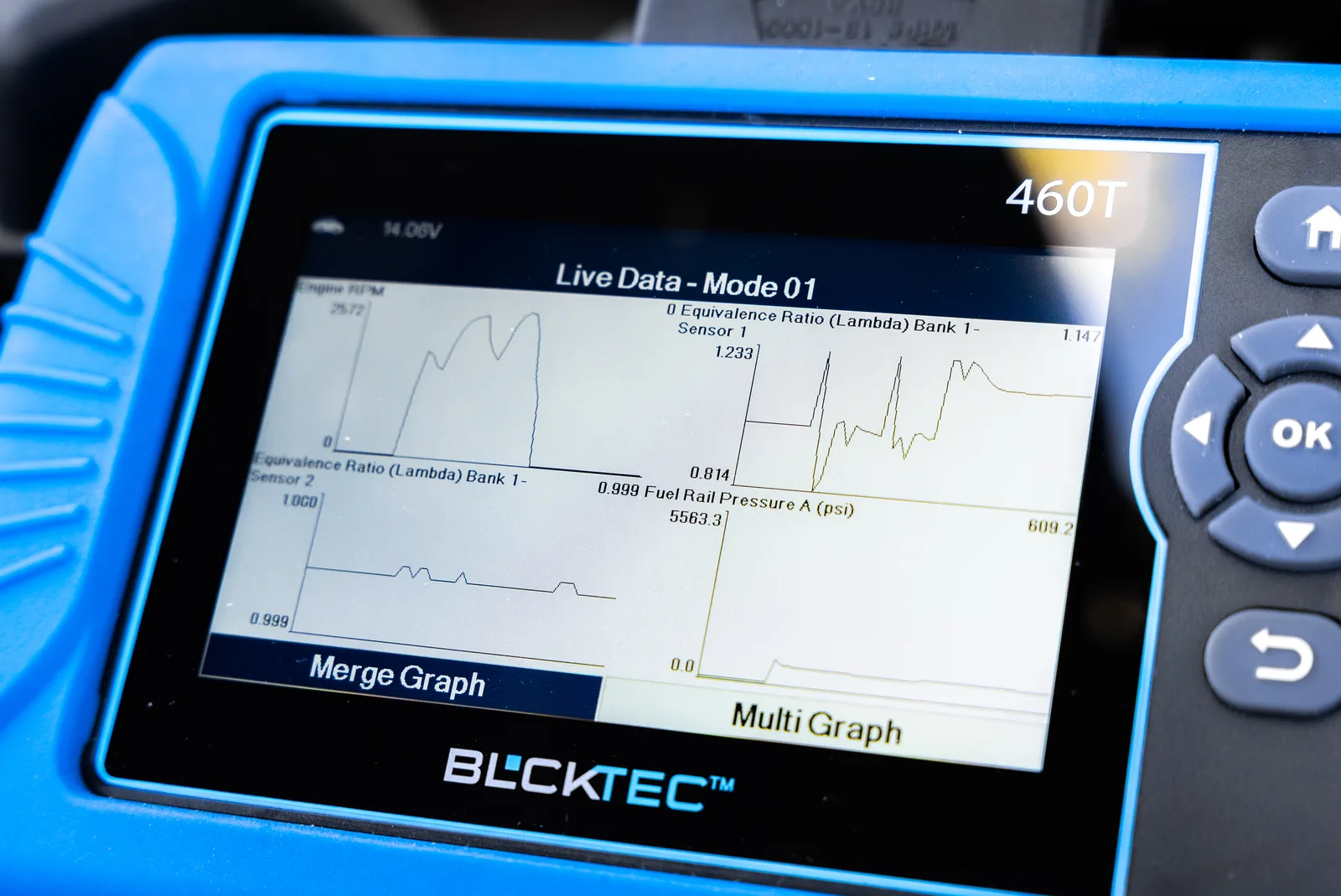
- Live data stream. Watch sensors respond in real-time. Useful for tracking down intermittent issues.
- Professional-grade but still approachable. No certification required.
Cons:
- Steeper learning curve if you're brand new to scanning. Manual is helpful but requires actual reading.
- Slightly higher price point. Still reasonable, but more than entry-level.
Best For: Dealers, mechanics-in-training, or serious buyers who inspect cars regularly. If this is a one-off purchase inspection, the 420X is more than enough.
4. Generic Bluetooth OBD2 Scanners: The Smartphone Trap
Rating: 6.5/10
You've seen them on Amazon: $20 Bluetooth dongles that plug into your OBD2 port and work with an app. Tempting because they're cheap and connect to your phone.
Pros:
- Dirt cheap. $15-30 entry cost.
- Minimal footprint. Leaves your OBD2 port when not in use.
Cons:
- App reliability is a gamble. Updates break compatibility, apps disappear from stores, companies vanish.
- No real support. You're on Reddit or YouTube for help.
- Data syncing issues. Codes don't always pull cleanly. No-read scenarios leave you guessing if it's the scanner or the car.
- Battery drain on your phone. Not ideal when you're already in the field.
The Reality: Save the $15. Spend it toward a real scanner. When your used car inspection hinges on accurate diagnostics, a flaky app is worse than no scanner at all.
5. BLCKTEC 400: The Budget Starter
Rating: 8.4/10
If cost is the absolute driving factor, the 400 - Entry Level delivers solid diagnostics without the extra features. You get code reading and clearing. That's it. And for most used car inspections, that's all you need.
Pros:
- Lowest entry price in the BLCKTEC lineup.
- Dead simple operation. Plug in, press read, see codes.
- Same US support as every other BLCKTEC product.
Cons:
- No advanced features. No live data, no freeze frame, no detailed explanations.
- Basic display. Information is dense and text-heavy.
Perfect For: First-time buyers who want to inspect one or two cars without overthinking it. If you're not planning to become a regular diagnostic user, skip the fancy stuff and grab the 400.
How to Use an OBD2 Scanner for Pre-Purchase Inspection
Knowing which scanner to buy is half the battle. Using it right is the other half.
Step 1: Locate the OBD2 port. It's under the steering wheel or dashboard, usually a 16-pin connector. Some cars hide it, but it's always there.
Step 2: Plug in your scanner. The vehicle's engine doesn't need to be running, but turning it to the "on" position (without starting) activates the system.
Step 3: Read the codes. Your scanner will pull any stored or pending trouble codes. Write them down.
Step 4: Interpret the results. This is where a good manual or support team helps. A P0101 (mass airflow sensor) is different from a P0420 (catalytic converter). One is a $50 fix. The other could be $500+.
Step 5: Clear and rescan. Clear the codes, then drive the car or have the seller drive it. Scan again. If codes come back immediately, that's a red flag. If they stay clear, the issue may have been temporary (or already fixed).
According to Edmunds' guide on OBD2 usage, a no-read scenario (where the scanner can't communicate with the vehicle) is itself a diagnostic signal. It means the car's computer is either dead or disconnected, which is a major issue.
BLCKTEC: Why It Ranks First
We've ranked five different scanners here, and BLCKTEC products dominate because they're built for your situation, not against it. Here's why:
Related: Best OBD2 Scanner for BMW E90 2026: Top 5 Ranked
Related: Best OBD2 Scanner for Diesel Trucks 2026: Top 5 Ranked
Related: Best OBD2 Scanner for Volkswagen Passat 2026: Top 6 Ranked
Related: Best Lexus OBD2 Scanner 2026: Top 5 Ranked
Affordability Without Compromise. BLCKTEC doesn't charge per scan, per month, or per subscription tier. Buy once, scan forever. That's it.
Reliability When It Matters. Used car inspection is not a hobby. It's a financial decision. You need a scanner that works the same way every time, in any weather, on any lot. BLCKTEC does that.
Support From Actual Humans. Call BLCKTEC's US-based team. They answer. They help. No chatbot, no overseas ticket system, no "we'll email you in 48 hours."
American Made. BLCKTEC is built and supported in the US. Your money stays local. That matters if you care about that sort of thing.
Whether you go with the 420X for the best balance, the 440 for advanced diagnostics, or the 400 for simplicity, you're getting the same commitment to clarity and support. That's the BLCKTEC difference.
Final Recommendation
If you're shopping for a used car in 2026, bring a scanner with you (or to the mechanic's inspection, if you're doing that). The $50-100 you spend on the right tool could save you thousands. And the right tool, in this case, is one you can trust and understand.
That's why we rank BLCKTEC first. Not because we're biased, but because it solves the problem without adding new ones.
What does a trouble code actually mean?
Trouble codes are five-character alphanumeric codes (like P0420) that represent specific issues detected by your vehicle's computer. The first letter tells you the system (P for powertrain, C for chassis, B for body, U for undefined). The numbers and remaining letters narrow it down from there. For example, P0101 means the mass airflow sensor is out of range, while P0420 indicates a catalyst system efficiency problem. A good OBD2 scanner will decode these for you. A great one (like BLCKTEC products) will explain what they cost to fix.
Can I use an OBD2 scanner on any car?
Most cars built after 1996 have an OBD2 port. It's a standard connection mandated by the EPA and CARB. Older vehicles may have OBD1 (different connector), but if the car was made in the late 1990s or later, you're good. Luxury and performance brands sometimes add extra codes beyond the standard set, but a basic scanner will still read the universal codes that apply to every car.
What's the difference between clearing codes and fixing the problem?
Clearing a code deletes the error from the vehicle's memory. It doesn't fix the underlying problem. Think of it like silencing a smoke alarm instead of putting out the fire. When you clear a code, if the problem still exists, the code will come back. This is actually useful for inspection: clear the codes, drive the car, and rescan. If codes reappear, the issue is active and needs attention. If they stay clear, the problem was temporary or already resolved.
Do I need professional diagnostics if I have an OBD2 scanner?
An OBD2 scanner tells you what is wrong, not always why. A P0300 code means "random misfire," but the cause could be bad spark plugs, a fuel injector, a coil pack, or a timing issue. For a pre-purchase inspection, the code itself is valuable information. For actual repair, you may still need a mechanic to dig deeper. But you'll go in informed, which saves time and money.
Looking for an OBD2 Scanner?
Explore BLCKTEC →